
A Mathematical Journey Through Networks, Chemistry, fixation of popularity, and Machine Learning.
Meditation on “what is the use?”
Speaker:
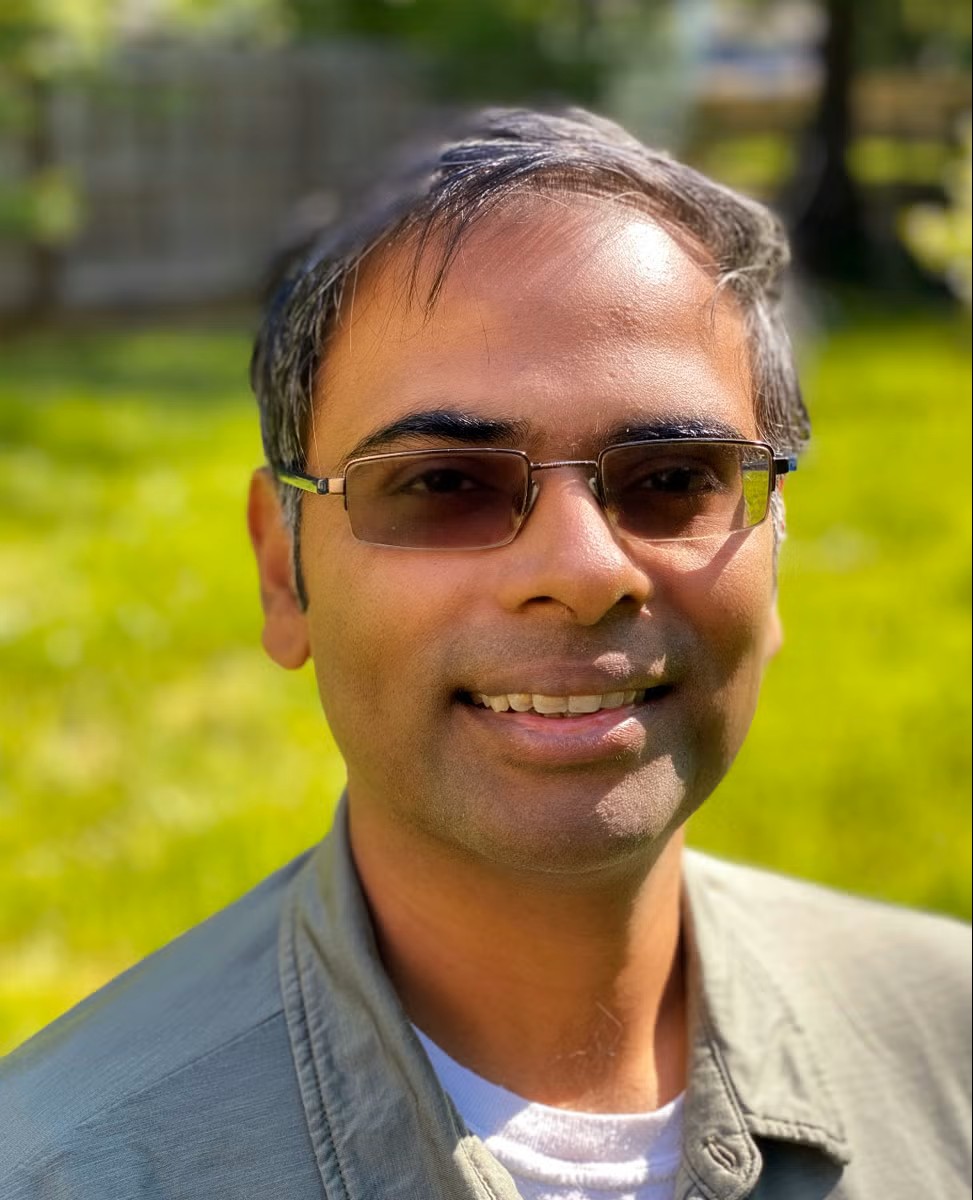 Dr. Shankar Bhamidi
University of North Carolina at Chapel Hill
https://shankarbhamidi.web.unc.edu/
Date & Time:
Friday, September 25, 2026
1:00 to 2:00 p.m.
Schmitt Auditorium
Reception to follow in Hovorka Atrium
About the Lecture
What is the use of learning something when its connection to our future plans is nowhere in sight? Students ask this question, but I used to regularly ask this as well. “What is the use of taking this course?” “I am super curious about this specific topic but I don’t see how it will help me in my career so let me move on” etc. In this public lecture, I will tell a story about what can happen when we follow curiosity before we know where it will lead, echoing John Lennon’s reminder, that life unfolds while we are busy making plans.
Our story begins with the minimum spanning tree. Given a network of possible connections, each with a cost, how can we connect everything as cheaply as possible? This deceptively simple object also lies behind single-linkage clustering, a foundational method for finding structure in unlabeled data. But what does this tree look like when the network (number of data points) is enormous and random? Numerical experiments in statistical physics suggested a remarkable answer: across many different models, its large-scale shape should be universal.
Turning that prediction into rigorous mathematics led through places that initially seemed far removed from machine learning. We will encounter models of particles merging in colloidal chemistry, a beautiful random process called the multiplicative coalescent, Erdős’s leader problem—a model for the fixation of popularity in political group formation, and network models in which a small amount of choice can influence how groups form. Each detour supplied an essential piece of the original puzzle.
No technical background will be assumed. The broader message is personal: many of the most rewarding things I have discovered came from being genuinely curious about questions whose immediate “use” I could not yet see. The converse was often equally revealing: things I pursued purely because they seemed useful for a specific career goal often failed to lead anywhere interesting.
About the Speaker
Shankar Bhamidi is a Professor in the Department of Statistics and Operations Research at the University of North Carolina at Chapel Hill. He works in both probability and statistics, and his research interests include research interests in stochastic processes, random graphs, and evolving network models. He is especially interested in problems that originate in applied areas of science and for which probability can provide useful and non-trivial insight.
Previous lectures
-
- 2024: Dr. Samuli SiItanen, University of Helsinki, “How AI Detects Cats in Photos Using Elementary School Math” Poster
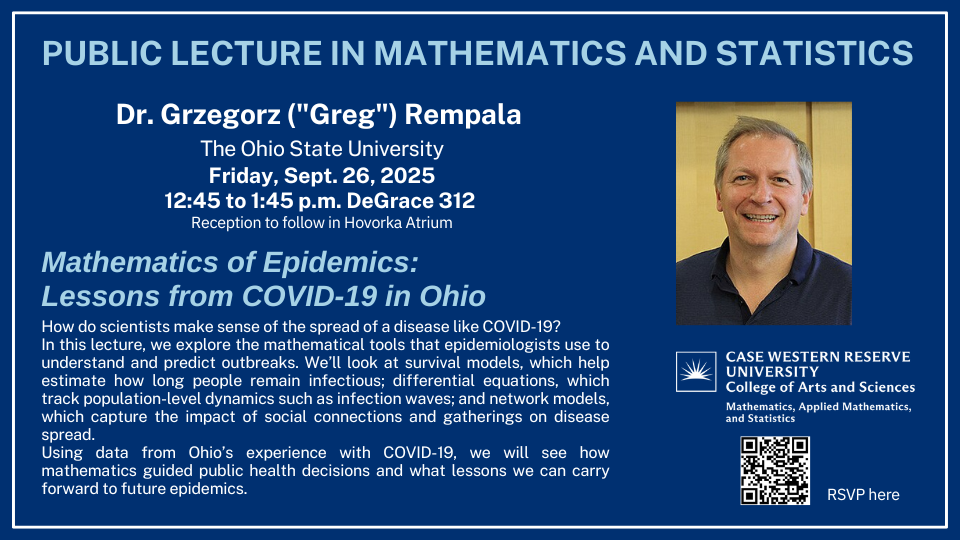
- 2025: Dr. Grzegorz (“Greg”) Rempala, The Ohio State University, “Mathematics of Epidemics: Lessons from COVID-19 in Ohio” Poster
Hosted by
Case Western Reserve University
College of Arts and Sciences
Department of Mathematics, Applied Mathematics, and Statistics
All are welcome! Please RSVP to attend.